
Roman Rimini: Arch of Augustus, Amphitheatre and What to See
Last updated November 2026: Rimini Roman heritage is real but compact, with the Arch of Augustus, the Tiberius Bridge and the amphitheatre remains all reachable on foot. Plan a short, focused visit rather than a Pompeii-style day, because this is a city better known for its beaches. For the wider picture, see our guide to Roman sites across Italy.
Featured image: Il Malatestiano, CC BY-SA 4.0, via Wikimedia Commons.
Roman Rimini at a Glance
Romans founded Ariminum in 268 BC, and three headline monuments still stand in the modern city. The Arch of Augustus dates to 27 BC. The Tiberius Bridge crosses the Marecchia on five arches. Amphitheatre fragments survive between the old walls and the seafront side. Verdict: worth a half day for history travelers and for beach holidaymakers who want one cultural outing. Skip it if you expect large excavated ruins, because Roman Rimini is a set of urban landmarks rather than an archaeological park.
- Best for: history travelers, day-trippers from Bologna or Ravenna, and beach visitors with a free half day.
- Not for: anyone who wants a big excavated site. Aquileia is a better match for that.
- Cost: the arch and bridge are outdoor monuments you view from the street.
A Short History: Why Ariminum Mattered
Romans founded Ariminum as a Latin colony in 268 BC, after the local Umbri were expelled during the Gallic War of 285–280 BC. Its name comes from the river Ariminus, today's Marecchia. That makes Ariminum, roughly, the city on the Marecchia. Rome saw the site between the Marecchia and the Ausa as a bastion against Celtic raids. It was also a springboard into the Po plain. Here the road network met the Adriatic. The Via Flaminia from Rome ended in Ariminum. The Via Aemilia ran toward Piacenza, and the Via Popilia led north. According to tradition, Julius Caesar spoke his famous "alea iacta est" in the forum of Ariminum in 49 BC, after crossing the Rubicon. Later, Augustus placed a fleet base at Ravenna. Ariminum lost its military role and became a trading port.
Roman Rimini: The Main Sites to See
Each stop below is a single monument rather than a large complex. Together they show how the colony looked at its gates, its river crossing and its entertainment district.
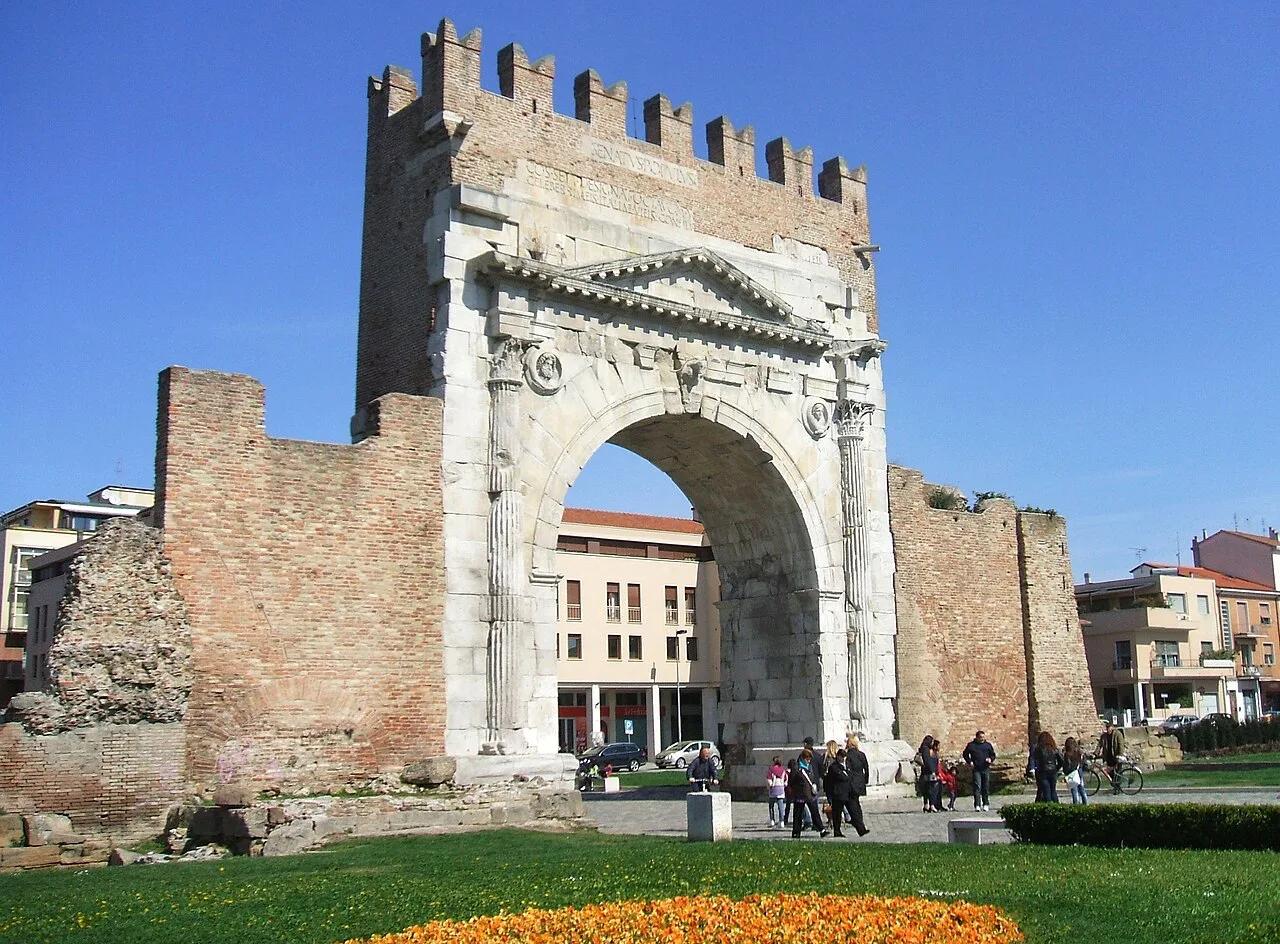
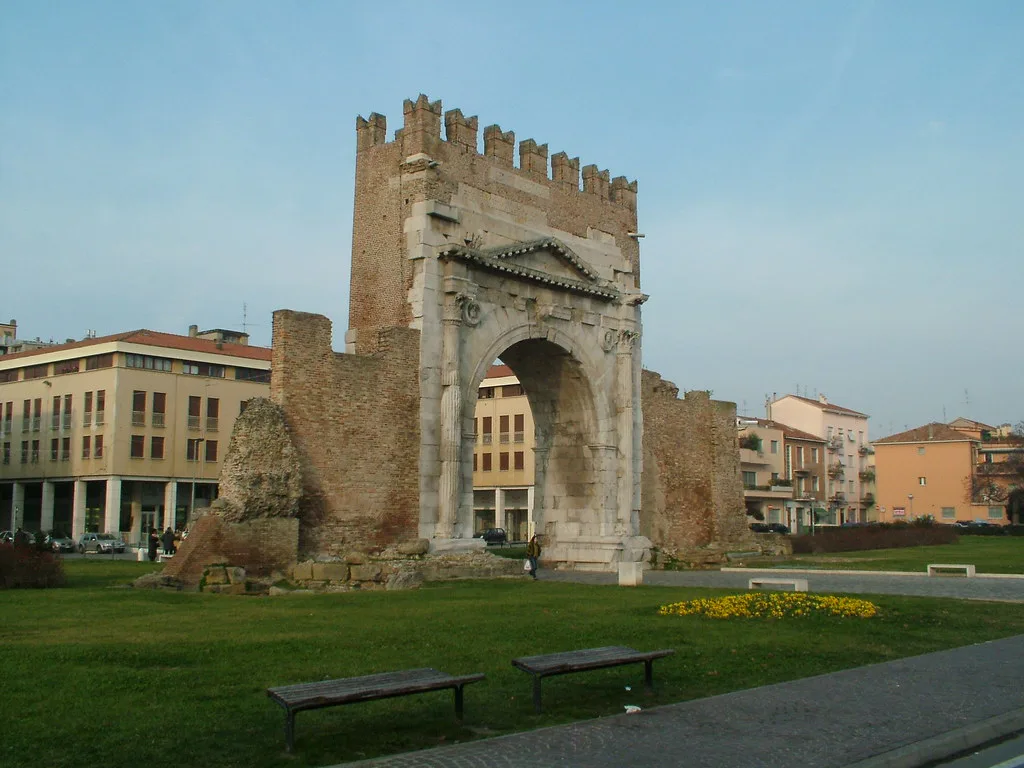
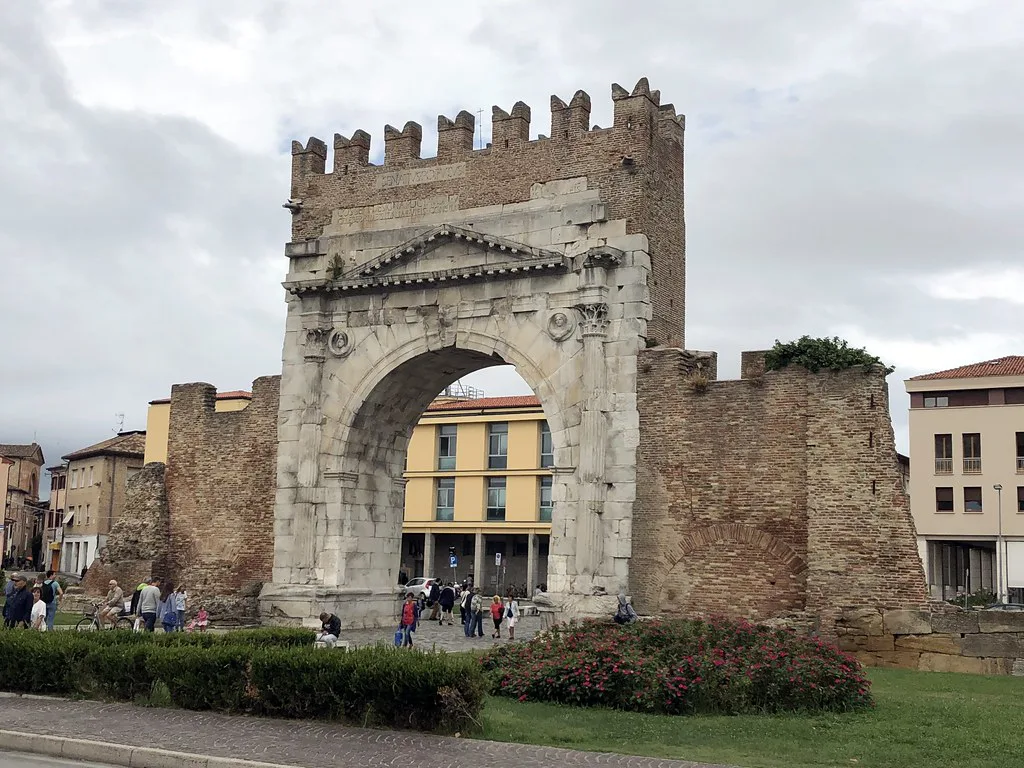
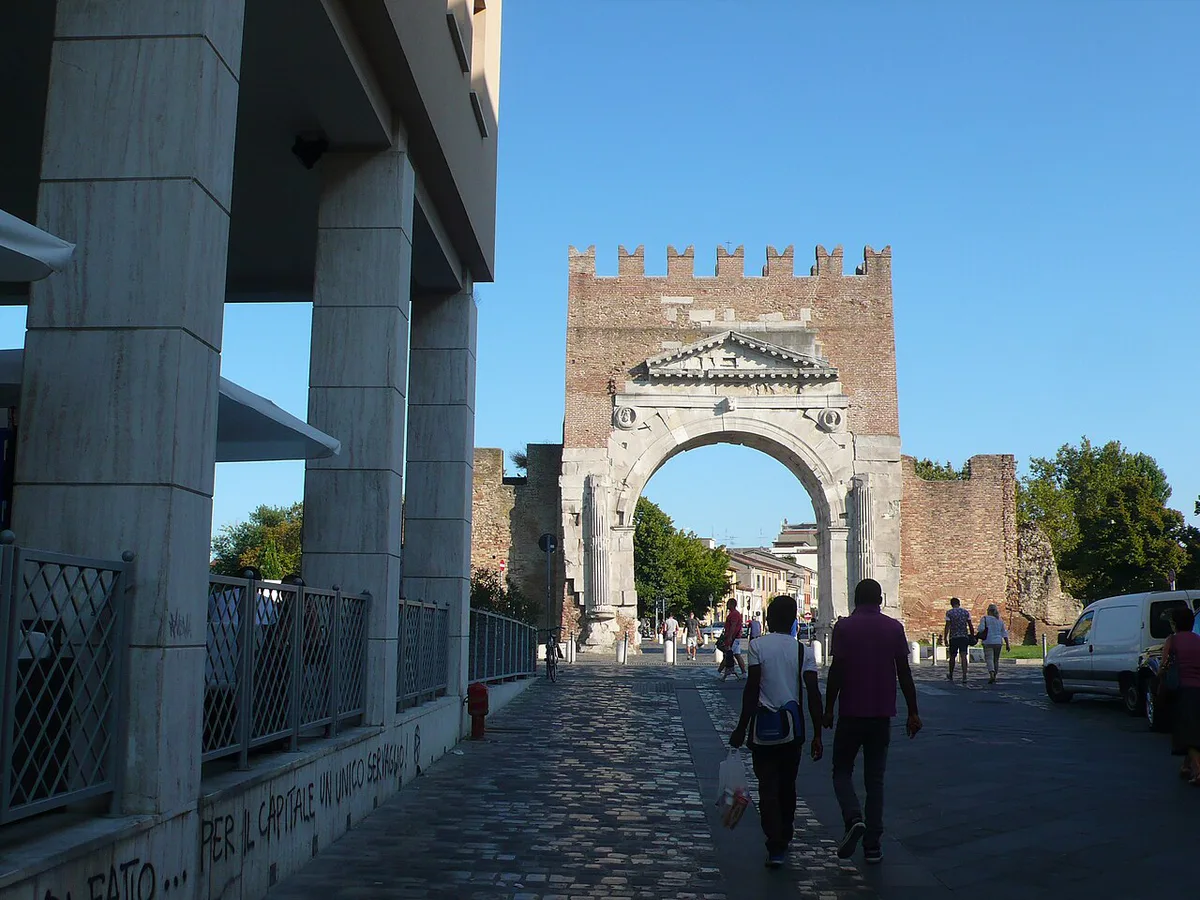
- Arch of Augustus: built in 27 BC as an open gate at one end of the Corso d'Augusto. Half-columns with Corinthian capitals frame the passage. Discs on the sides show Roman gods, and remnants of the old wall and towers flank it.
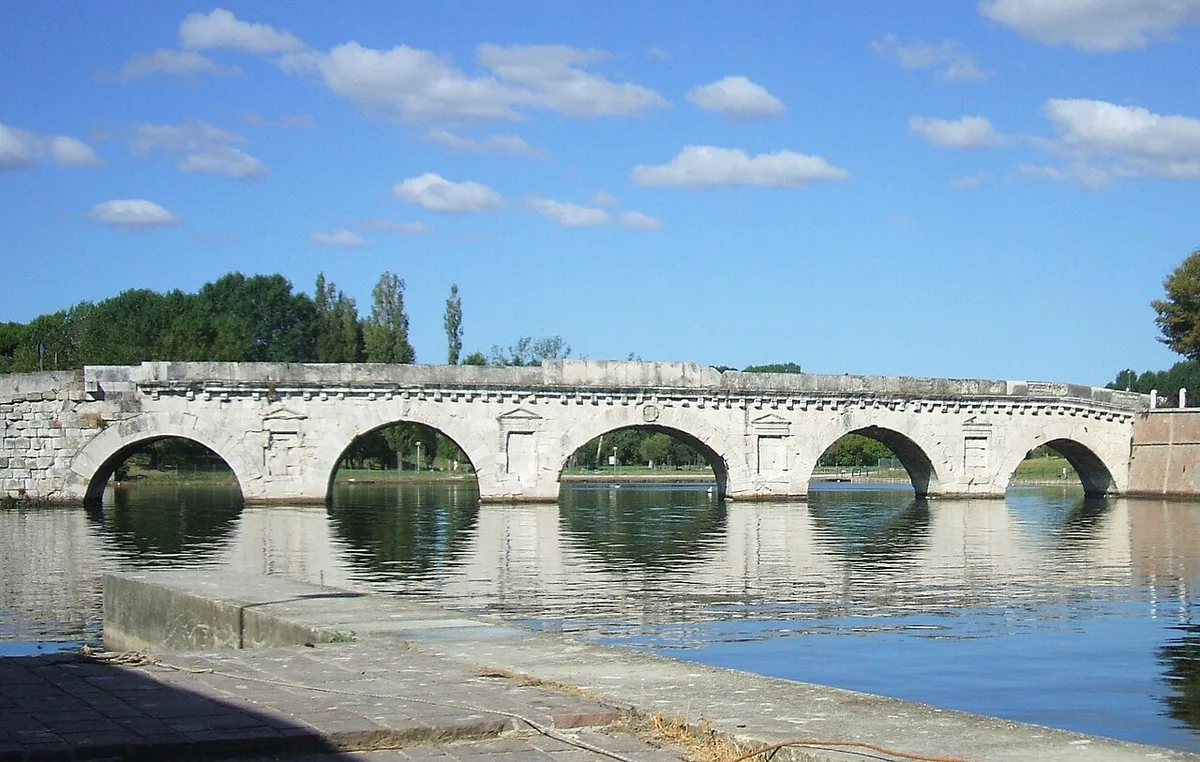
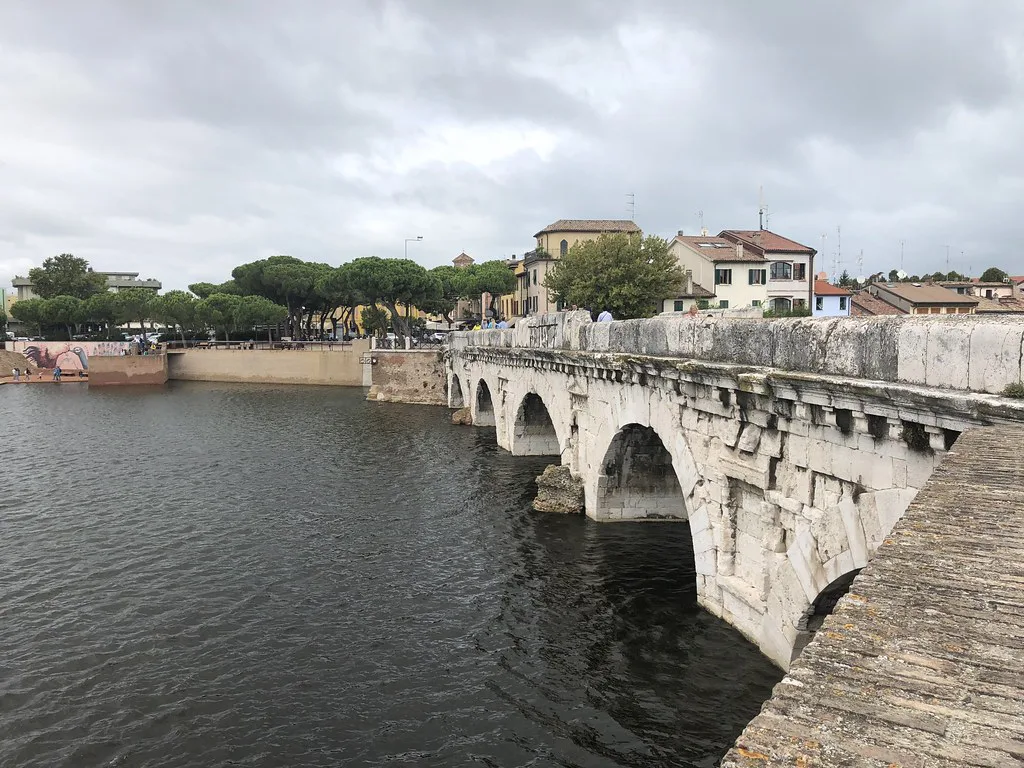
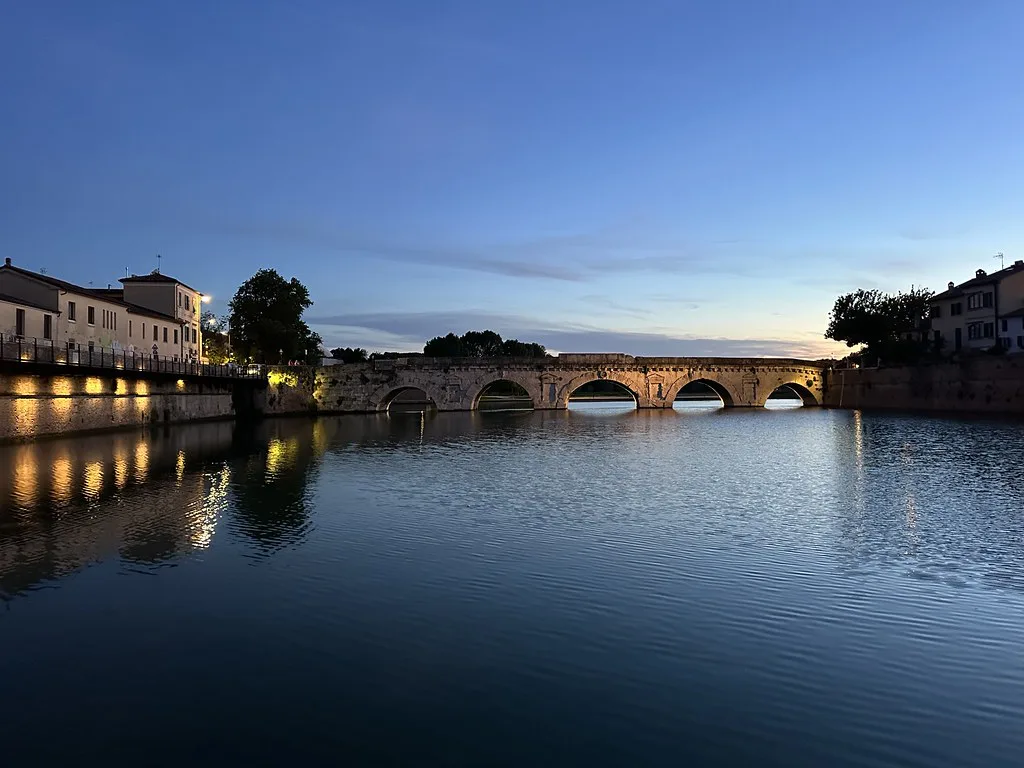
- Tiberius Bridge: built between 14 and 21 AD in honour of Augustus and Tiberius. Five arches of different sizes carry it over the Marecchia. Roman roads toward the Via Aemilia and Via Popilia began here.
- Amphitheatre remains: stairs, arches and perimeter-wall fragments survive near the city museum. Estimated dimensions are 118 m by 88 m, with room for roughly 10,000 to 12,000 spectators. Luigi Tonini identified it in 1843. Dating is debated between the time of Augustus and the 2nd century AD under Hadrian.
- Surgeon's House (Domus del Chirurgo): a Roman house at Piazza Ferrari. It gives a domestic view of Ariminum to set beside the monuments.
- Montanara Gate: a sandstone round arch at the end of Via Garibaldi. It dates to the 1st century BC and is only one half of the original double gate.
- City museum: its Roman collection is the place to see objects from the town. Check the museum's page for what is on display.
What You Won't See: The Lost Harbour and Buried City
Do not plan a Roman port visit. Silting and river sediment pushed the coastline seaward, so today's shore sits well east of the ancient one. Researchers broadly agree that the harbour mole lies beneath the square by the current railway station. Its exact layout is still argued. Later builders also reused ancient harbour stone in the Malatesta Temple around 1450. Much of Ariminum lies under the modern city, so treat the harbour as background context and not as a stop on your route.
A Walkable Route and Time Plan
Use the Corso d'Augusto as your spine. It runs from the Arch of Augustus toward the Tiberius Bridge, and the main stops string along or near it. Add the amphitheatre and the Surgeon's House as short detours. Resort season runs from June through August, when heat and crowds are heaviest. Spring and autumn are more comfortable for walking between monuments.
| Stop | What it is | How much remains | Access | Best for |
|---|---|---|---|---|
| Arch of Augustus | City gate, 27 BC | Complete arch with wall and tower remnants | Street-side monument | First stop and photos |
| Tiberius Bridge | River crossing, 14–21 AD | Five arches over the Marecchia | Street-side monument | Walking the Roman axis |
| Amphitheatre | Gladiatorial arena | Fragments of arches, steps and walls | Check Musei Rimini | Imagining Ariminum's scale |
| Surgeon's House | Roman domus, Piazza Ferrari | Domestic remains | Check Musei Rimini | Everyday Roman life |
| Montanara Gate | Round arch at Via Garibaldi | One half of a double gate | Street-side monument | Quick add-on |
- One hour: Arch of Augustus and Tiberius Bridge along the Corso d'Augusto.
- Half day: add the amphitheatre, the Surgeon's House and the city museum's Roman collection.
- Full day: add Montanara Gate, then pair the Roman sights with the Malatesta Temple.
Tickets and Hours
Arch of Augustus and Tiberius Bridge are outdoor monuments you can see from the street. For the amphitheatre, the Surgeon's House and the city museum, Musei Rimini's official site lists current fees and closing days.
Getting There and Getting Around
Rimini has a railway station, and trains are the simplest way to reach the city from Bologna or Ravenna. Walking is the best way to link the monuments once you arrive. Drivers should note that the historic centre has a limited-traffic zone (ZTL), so park outside it and check signs before entering. Ravenna also pairs well with Rimini in a Roman-themed day, since Augustus based a fleet there. For local maps and visitor services, use Rimini's tourism site.
Where to Base Yourself
Stay in the historic centre if the Roman monuments are your priority, since the Corso d'Augusto puts the arch and bridge within walking distance. Beach-first travelers can stay on the seafront and make the Roman outing a half-day trip. Choose by how you will spend most of your time, and use the 1-hour or half-day plan above to fit the monuments in.
Rimini Beyond Rome: Malatesta Temple and Fellini
Sigismondo Malatesta, lord of Rimini from 1432 to 1468, had a classical-style church built around 1450. The Malatesta Temple was never completed. It pairs well with the Roman stops for a Renaissance counterpoint. Fellini sights suit a second day, after the ancient monuments are done.
Mistakes to Avoid
Most disappointment comes from mismatched expectations, not from the monuments themselves.
Estimated at 118 m by 88 m, the amphitheatre sounds large, yet only stairs, arches and wall fragments survive. Judge it by the fragments, not the footprint.
- Expecting Pompeii: Rimini's Roman sites are scattered urban landmarks.
- Staying on the beach strip: the monuments sit inland along the Corso d'Augusto.
- Skipping closing days: check Musei Rimini before you plan a museum or amphitheatre stop.
Where Else to See Roman Italy
Rimini works best as one stop on a wider Roman route. Use these pages to choose what comes next.
- Aquileia's northern Adriatic ruins: a larger Roman site if you want more excavated remains.
- Roman Aosta: a Roman town in the Alps with its own gate and theatre.
- Luni's Roman town: a coastal Roman site to pair with a northern Italy trip.
- Roman Cosa: a hilltop colony site on the Tuscan coast.
- Ruins around Naples: a southern contrast, with the scale Rimini lacks.
Starting from Rimini Station
From Rimini railway station, walk inland toward the historic centre rather than toward the beach. The station area is useful for arrival, but it is not a Roman harbour stop. The ancient harbour is buried beneath the modern city, and its exact layout remains debated.
For a 1-hour visit, begin at the Arch of Augustus, built in 27 BC, then follow Corso d'Augusto through the centre to the Tiberius Bridge. The bridge was built between 14 and 21 AD and marks the northern end of this Roman axis.
Allow a half day if you also want the Surgeon’s House, city museum and amphitheatre remains. The amphitheatre lies on the seafront side of the old centre, so it works best as a detour after the central monuments. Check Musei Rimini before relying on museum or amphitheatre access.
Frequently Asked Questions
Is Rimini, Italy worth visiting?
Yes, for beaches and for a compact dose of Roman history. The Arch of Augustus, the Tiberius Bridge and the amphitheatre fit into a half day. Expect landmarks rather than a large archaeological park.
Related guides



Continue reading
Guides on the same trip



