
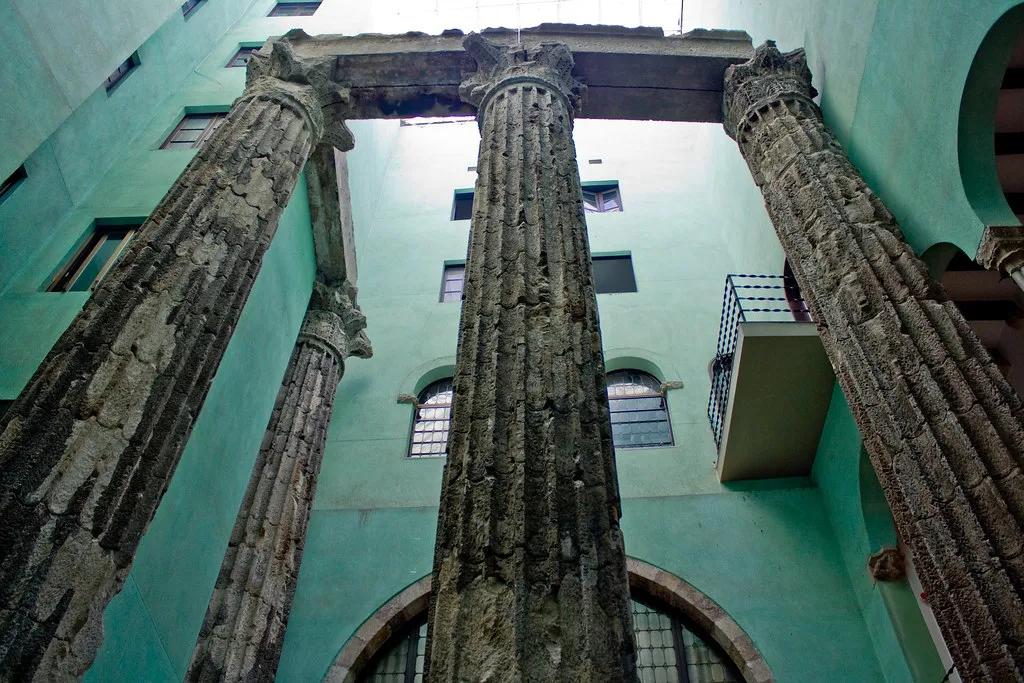
Last updated November 2026. Roman Barcelona means Barcino, a small colony whose surviving remains sit inside the Gothic Quarter (Barri Gòtic). Most of it fits into one walk between Plaça Nova and Plaça del Rei. Expect fragments among medieval buildings, not a Pompeii-style site, and read our guide to Spain's archaeological sites if you want bigger ruins elsewhere.
Featured image: Rich B-S, CC BY 2.0, via Flickr.
Roman Barcelona at a Glance
Barcino was founded as a Roman colony nearly 2,000 years ago, and its walls are the most visible survivor. Most of the stone you see today dates from the 4th century, when the original walls were reinforced with towers. Outdoor stretches are public street sights. The underground ruins and the Temple of Augustus columns are indoors and have their own access rules. One hour covers the main street-level stops. Add the museum and you have a half day.
- Best for: first-time visitors already staying near the Gothic Quarter.
- Skip if: you want large open ruins with signposted paths.
- Linger if: you enjoy spotting reused Roman stone in medieval walls.
What Barcino Was and What Is Left
Barcino was a small walled colony on the low hill the Romans called Mons Taber. Its streets followed the usual Roman grid. The Cardo ran roughly where Carrer del Bisbe is today. The Decumanus crossed it near Baixada de la Llibreteria. The Forum stood at their junction, now Plaça de Sant Jaume. Medieval palaces and houses were later built directly onto the Roman ramparts. That layering is the real attraction.
To read the stones, look for three things. Large regular Roman blocks form the base. Mixed reused pieces, such as column drums and carved fragments, show hurried 4th-century building. Smaller medieval masonry sits on top. Once you can tell them apart, every wall stretch becomes easier to understand.
A Walking Route Through Roman Barcelona
Start at Plaça Nova and finish at Plaça del Rei. The legs between neighbouring squares are short, so there is no need to count minutes. For a short version, do stops 1 to 3 and then stop 5. For the long version, do all six, then add the necropolis at Plaça Villa de Madrid, which lies outside the old walled precinct and has 70 tombs from the ancient burial ground.
Free, street-level walls at stops 1 to 3 suit the early or late light the timing advice recommends.
| Stop | What survives | Access | Worth a stop? |
|---|---|---|---|
| 1. Plaça Nova | Two gate towers and a modern replica of an aqueduct section beside the Casa de l'Ardiaca | Free, street level | Yes, the clearest single view |
| 2. Carrer de la Tapineria and Carrer de la Palla | Wall stretches with later buildings above | Free, street level | Yes, for the layering |
| 3. Plaça Ramon Berenguer el Gran | Wall with medieval structures built on top | Free, street level | Yes, good for photos |
| 4. Carrer del Bisbe and Baixada de la Llibreteria | Street lines of the old Cardo and Decumanus | Free, street level | Skippable, nothing visible but the layout |
| 5. Plaça de Sant Jaume | Site of the Forum | Free, street level | Quick look only |
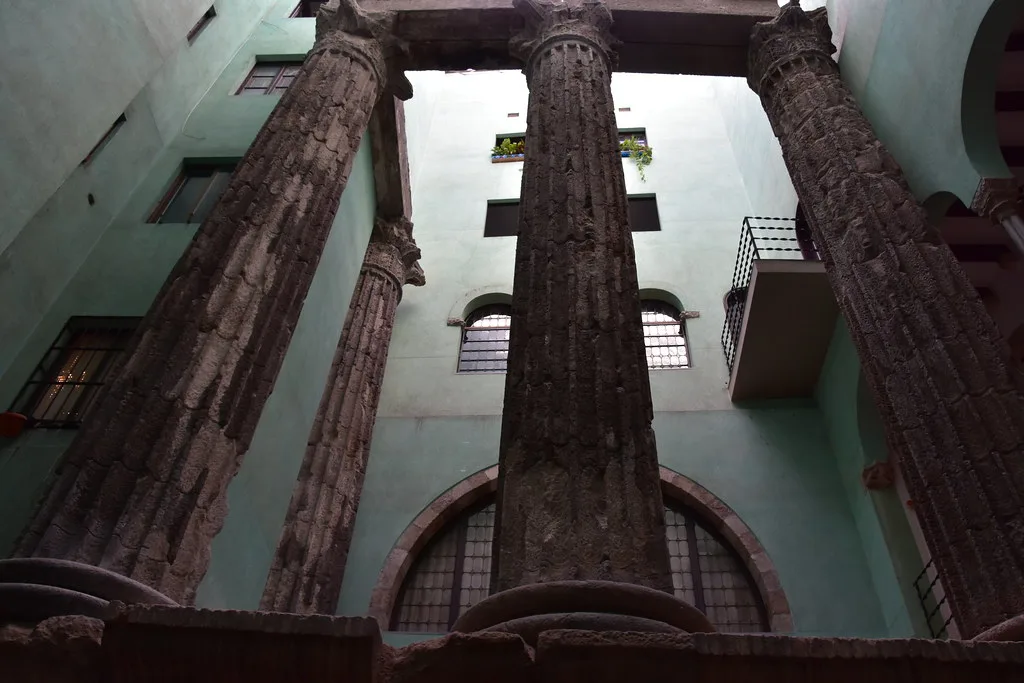
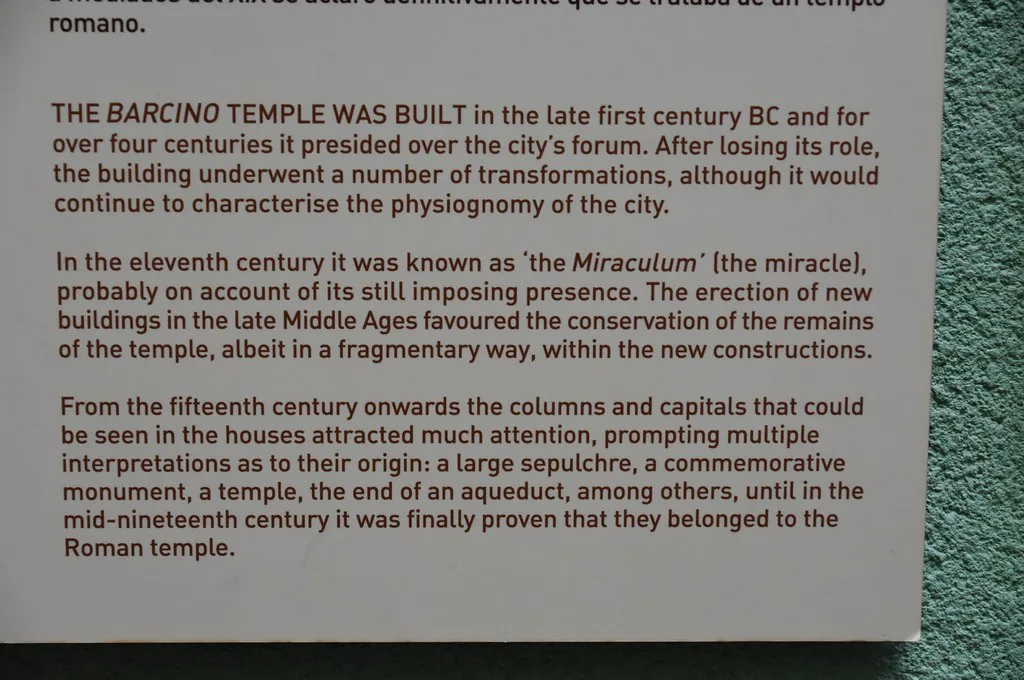
| 6. Carrer del Paradís | Four columns of the Temple of Augustus, inside the Centre Excursionista de Catalunya | Indoor, check access | Yes, if open when you pass |
| 7. Plaça del Rei | Underground Barcino ensemble in the museum | Ticketed | Yes, the deepest look |
Museum and Underground Ruins: Is It Worth Paying?
The Barcelona History Museum (MUHBA) at Plaça del Rei presents the archaeological ensemble of ancient Barcino beneath the square. It is the one stop that shows the Roman city below street level instead of in a wall fragment. Check opening days and current ticket prices on the MUHBA official site before you plan the day. Choose it if you want context for the walk. Skip it if the free outdoor stops already answer your curiosity.
Tickets, Passes and Tours: What Actually Helps
The city's tourism site lists several products alongside its Roman route. Its listed starting prices include €14.50 for the Arqueoticket, €15.00 for the Barcelona Card and €17.77 for the Hola Barcelona travel card. Guided Gothic Quarter walks start at €18.00 and €25.65 there. Prices and details were checked November 2026 on the Barcelona tourism site, and they change.
Stops 1 to 3 need no ticket, so walk them first before deciding on the €14.50 Arqueoticket.
For Roman sights alone, a free self-guided walk plus one museum ticket is usually enough. A guided tour helps if you want the layering explained on site. A hop-on bus is a poor fit, because the remains sit in a pedestrian old town.
| Option | What it is for | Matters for a Roman trip? | Suits |
|---|---|---|---|
| Free walk only | Walls, towers, Forum site | Yes, covers stops 1 to 5 | Short stays, tight budgets |
| Arqueoticket | Archaeology-themed ticket from the tourism board | Yes, check what it includes | Museum-focused visitors |
| Barcelona Card | Multi-attraction city card | Only if you visit other sights | Packed itineraries |
| Hola Barcelona travel card | Transport card | No, the route is walkable | Longer stays using transit |
| Articket | Art museum pass | No, art focus | Art-focused trips |
| Guided Gothic Quarter walk | Commentary on the old town | Helpful for the layering | First-timers who want a story |
Opening Hours, Access and Best Time to Go
The wall stretches and Plaça Nova towers are outdoor public streets, so you can see them at any hour. Indoor sights keep their own schedules, including closing days. Evening visits suit the exterior stops, though the museum and the Temple of Augustus columns will not be open to browse. Lanes in the Gothic Quarter are narrow and cobbled, so wear flat shoes. In midday heat or rain, shift the museum to that slot and keep the wall walk for early or late light.
- Mistake: expecting a large archaeological park.
- Mistake: relying on a hop-on bus to see the walls.
- Mistake: arriving at the museum without checking its closing day.
- Mistake: seeing only Plaça Nova and missing the other wall stretches.
Getting There and Where to Base Yourself
Everything here is inside the Gothic Quarter, so base yourself in or beside it and walk. Plaça Nova and Plaça de Sant Jaume are the natural start and midpoint. Check the city's transport pages for the nearest metro station to your hotel, since the route itself is pedestrian.
Roman Barcelona Beyond the City
Barcino is small, so pair it with larger sites. The Roman and Greek ruins at Empúries are the closest in Catalonia, and the MAC Empúries page has visitor details. For the earlier Iberian layer, see the Iberian town at Ullastret. Further afield, Roman Zaragoza and the Roman theatre town of Sagunto offer more. Inland, Segóbriga and Clunia show Roman towns in open countryside.
Frequently Asked Questions
What was Barcelona called during Roman times?
It was called Barcino. The small walled colony sat on Mons Taber, in what is now the Gothic Quarter.
What is special about the Gothic Quarter in Barcelona?
It holds the surviving Roman wall stretches, towers and the Forum site. Medieval buildings were built directly onto the Roman stone, so both layers stand together.
Related guides
Continue reading
Guides on the same trip